


Key Takeaways
- Nikkei 225 fell more than 4% from its record high as tech stocks led the pullback
- The index still surged around 35% for the quarter, its biggest quarterly gain on record
- Japan’s rally has far outpaced the US, Europe, and China
- Leadership is rotating from chipmakers into component and power infrastructure names
- Murata is up 268% this year and Taiyo Yuden has surged 438%
- Heavy tech concentration (around 35% of the index) keeps the risk elevated
- Accelerating Tokyo inflation has revived bets on further Bank of Japan rate hikes
The Nikkei 225 pulled back sharply from the record highs it reached during a remarkable quarter-long rally, with technology stocks leading the retreat.
Even after the drop, the index still surged around 35% for the quarter. That stands as the biggest quarterly gain in its entire history.
The decline came as investors locked in profits following the steep advance. But the broader uptrend remains firmly intact.
What makes Japan’s rally stand out is its sheer scale. The Nikkei’s gain has far outpaced major indexes in the United States, Europe, and China.
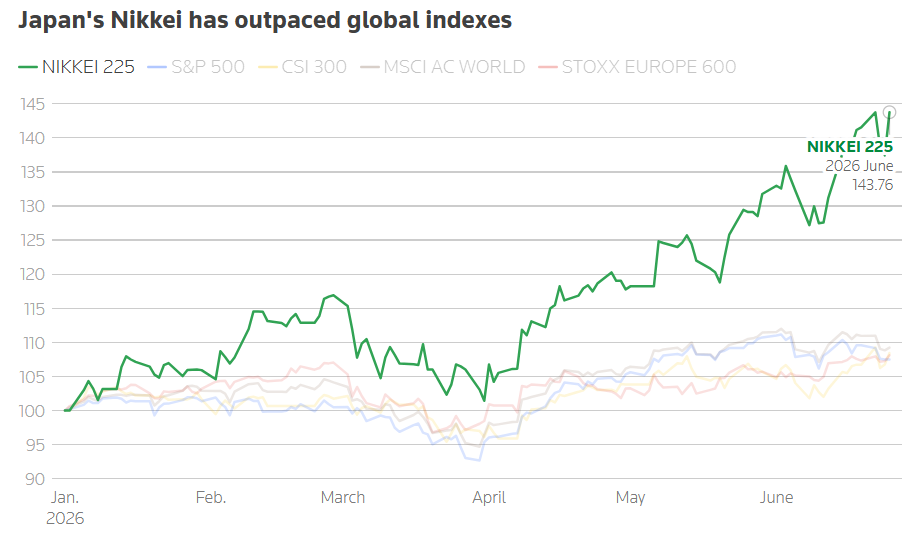
Source: Reuters
The story is no longer just about AI enthusiasm lifting shares everywhere. In Japan, it has become a question of who is left to buy.
Apple’s Price Hikes Rattle Chip Names
The latest leg lower was triggered partly from abroad. A wave of selling in US megacap technology stocks spilled into Asian markets, dragging Japan’s heavyweight chip names down with it.
Apple’s move to raise prices on its devices, a response to surging memory and storage chip costs, served as a warning that higher component costs could eventually squeeze the broader tech ecosystem.
Sentiment took a further hit from reports that OpenAI may delay its public market debut. That weighed heavily on SoftBank Group, a major backer of the AI firm, whose shares slumped and helped drag the wider index lower.
The selling soon rippled across Japan’s other big exporters, with Advantest, Tokyo Electron, Kioxia, and Taiyo Yuden among the steepest decliners as investors turned cautious.
It was a reminder of just how tightly Japan’s market is now tied to the global AI trade, for better and for worse.
The Rally’s Evolving Story
Japan’s surge has moved through distinct phases, and understanding them explains where the index might head next.
The first AI wave was driven by now-familiar names. SoftBank, Advantest, and Tokyo Electron led the charge as global AI investment expectations took hold.
A second leg brought in suppliers. Fibre-optic cable makers like Fujikura and Furukawa Electric joined the advance as the AI buildout broadened.
Now a third wave is spreading. It is moving into the components and power infrastructure that data centres simply cannot run without.
The Third Wave Takes Over
Murata Manufacturing and Taiyo Yuden have emerged as the latest engines of the rally. Both are leading makers of multi-layer ceramic capacitors used to regulate power in AI servers.
The numbers are striking. Murata’s shares have risen 268% so far this year, while Taiyo Yuden has surged an astonishing 438%.
Taiyo Yuden now trails only memory maker Kioxia, which overtook Toyota Motor this month to become Japan’s most valuable company.
Ibiden, a supplier to AI bellwether Nvidia, is another standout, up 292%. The latest name to join is Panasonic Holdings, which hit a record high after announcing plans to mass-produce data centre battery cells in Kansas.
As Kazuaki Shimada, chief strategist at IwaiCosmo Securities, sees it, this is just the beginning. Investors are expected to keep hunting for stocks tied to AI data centres.
The Concentration Risk
The broadening rally is encouraging, but the Nikkei’s heavy tech tilt remains a clear vulnerability.
Chip-related names like Tokyo Electron, Advantest, and Kioxia account for about 25% of the index’s value.
Add in adjacent companies such as Murata, Sony Group, and Kyocera, and that weighting climbs to roughly 35%.
That concentration cuts both ways. When these stocks rally, the index rises fast, but when they fall, it can correct just as sharply.
The Philadelphia Semiconductor Index, a key US tech benchmark, recently traded more than 70% above its 200-day average. That is widely seen as a sign of overheating.
According to Takamasa Ikeda, senior portfolio manager at GCI Asset Management, it may be hard for the SOX to hold its momentum over the longer term. And if it corrects, the Nikkei could struggle to avoid the same fate.
The Rate Hike Question Looms
Beyond the tech story, a domestic factor is also creeping into view.
Tokyo’s core inflation rate recently accelerated for the first time in eight months. That has strengthened expectations the Bank of Japan will keep raising interest rates.
Higher rates would mark a clear shift away from the era of ultra-cheap money that helped fuel Japan’s equity boom. For a market priced for momentum, any hawkish surprise from the BOJ could add another layer of pressure.
Technical Analysis
The Nikkei 225 was rejected at resistance around 72,650 and has formed a potential double top pattern. This suggests a possible reversal toward lower prices.
A break below the 68,550 support level could signal a shift into a short-term bearish trend.
The moving average indicator is starting to show a bearish crossover, while the MACD is displaying a bearish histogram. The MACD signal line moving below the 50 level reinforces the short-term downside pressure.
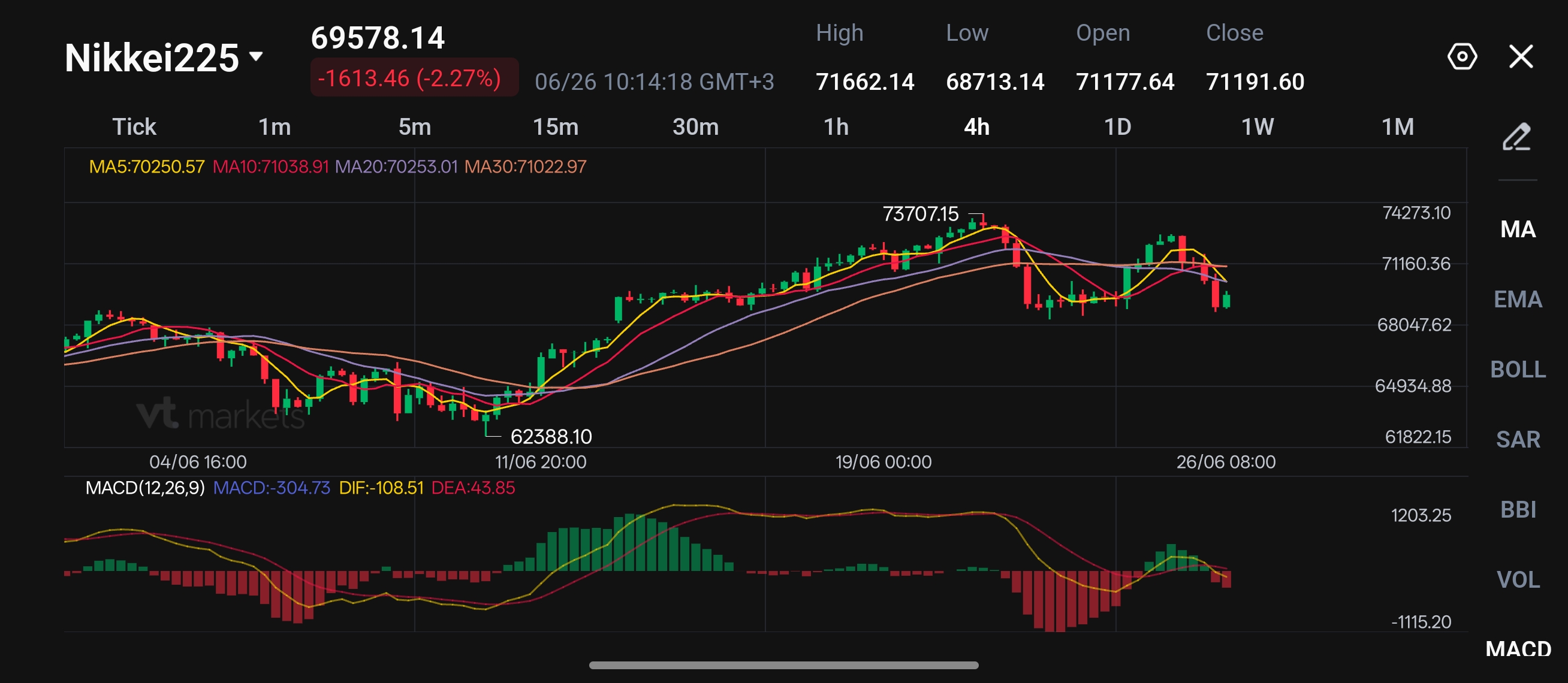
Key levels to watch:
- Resistance: 72,672
- Support: 68,764
- Major Support: 65,567
Cautious Forecast
The Nikkei may stay supported if AI-related earnings hold up, semiconductor demand remains strong, and global risk sentiment stabilises.
That said, further downside could emerge if profit-taking spreads across high-growth tech names, if volatility in global chip stocks picks up, or if the Bank of Japan turns more hawkish than expected.
Traders will likely focus on the pace of rotation into second and third-wave AI beneficiaries, earnings from key technology exporters, the direction of the US chip sector, and signals from the BOJ for clearer direction.
Learn more about trading Indices on VT Markets here.
Frequently Asked Questions
Why did the Nikkei fall after a strong rally?
The index declined mainly because investors began taking profits after a historic multi-month rally driven by AI-related stocks. A fresh wave of selling in US megacap tech, sparked partly by Apple raising prices to offset rising chip costs, added to the caution. After such a sharp climb, many traders trimmed exposure in technology and semiconductor names that had led the advance. The pullback is widely viewed as a correction rather than a reversal.
Is the Nikkei still in an uptrend?
Yes. Even after the recent decline, the broader trend remains upward. The index still posted a gain of around 35% for the quarter, its biggest quarterly gain on record. The advance continues to be supported by AI-related sectors, though the heavy concentration of tech stocks means any sustained weakness in chips could test that trend.
What is driving the AI rotation in the market?
The market is gradually shifting from early-stage AI winners like Advantest and Tokyo Electron into other parts of the supply chain. This now includes component makers such as Murata and Taiyo Yuden, power infrastructure firms, and companies like Panasonic building out data centre battery capacity. This kind of rotation often follows a strong rally, when investors look for the next group of beneficiaries.
Does concentration in tech increase risk for the Nikkei?
Yes, significantly. Chip-related names make up about 25% of the index, and including adjacent tech companies pushes that to around 35%. This means a small number of stocks can move the entire index. When they rally, the Nikkei rises quickly, but when they fall, it can correct sharply. The Philadelphia Semiconductor Index recently traded more than 70% above its 200-day average, which many see as a warning sign.
What could determine the next move in the Nikkei?
The next direction will likely depend on earnings from AI-related companies, global semiconductor demand, the performance of the US chip sector, and the Bank of Japan’s policy path. With Tokyo inflation accelerating, the prospect of further rate hikes has become a key factor. Continued strength in AI infrastructure spending may support the index, while sustained profit-taking, a chip-sector correction, or a hawkish BOJ could lead to further consolidation.
Start trading now – Click here to create your real VT Markets account